455M+
Creator profiles you can query across Instagram, TikTok and YouTube.

Build creator search, profile enrichment and audience analysis into your own product or workflow. Access structured Instagram, TikTok and YouTube creator data through the IQFluence API, then sync the fields your CRM, dashboard or research pipeline actually needs.
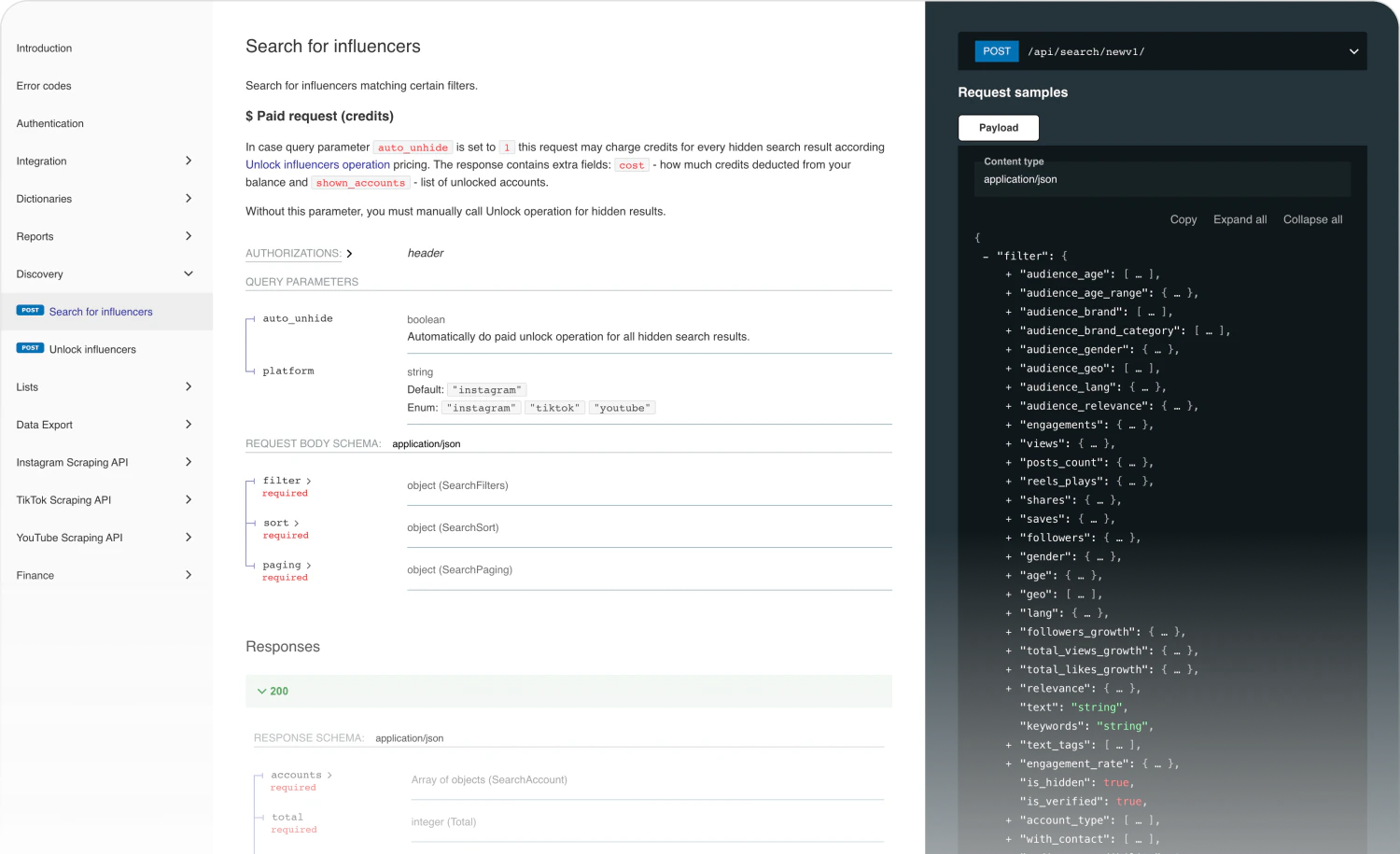
Influencer marketing API: programmatic access to structured creator data your own product can call
Featured in Influencer Marketing Hub Top Platforms 2026 • 5.0 on Capterra








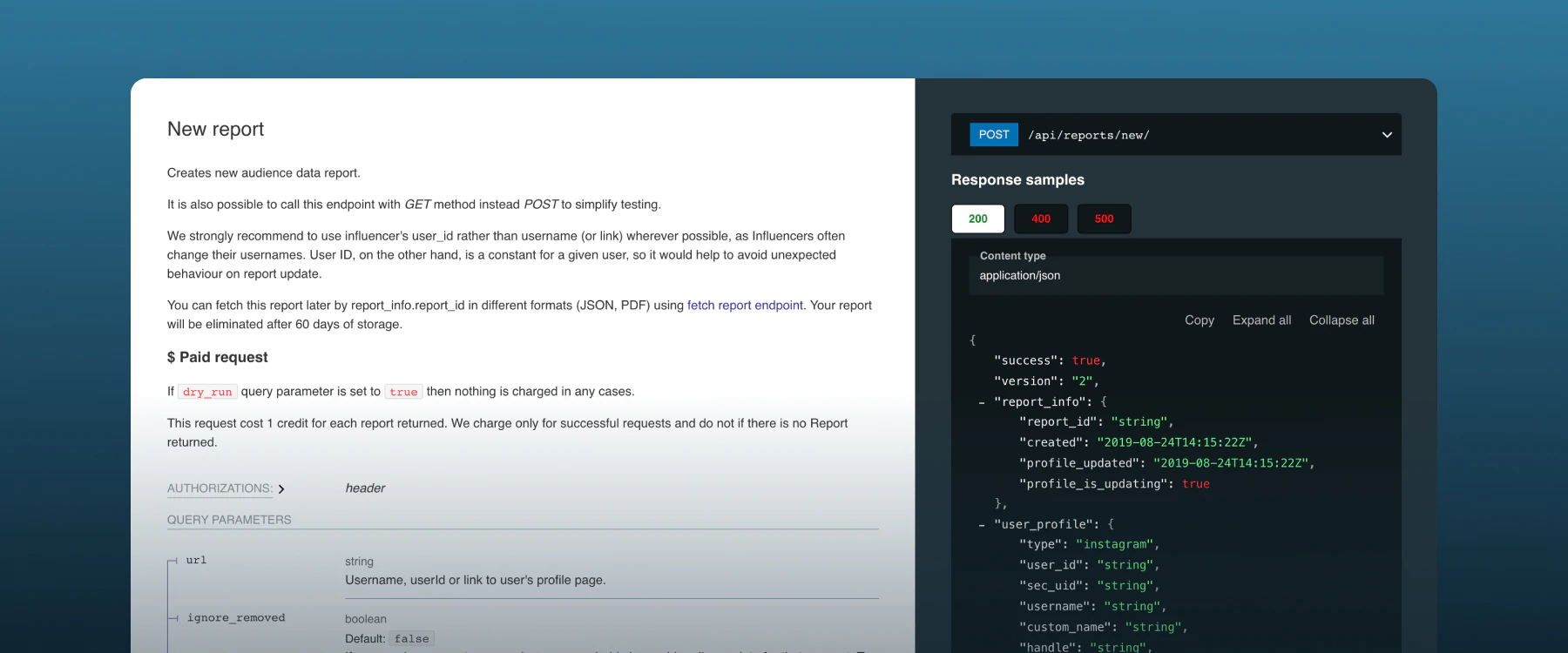
Discovery, profile and audience enrichment, overlap checks, contact enrichment and campaign reporting all run from one key, across Instagram, TikTok and YouTube. The request below is the real shape of it: authenticate, send criteria, read structured records back.
Coverage and throughput
Before you size credits or design a queue, these are the three limits worth building around.
Creator profiles you can query across Instagram, TikTok and YouTube.
Requests per second supported. Confirm the ceiling for your plan and endpoints.
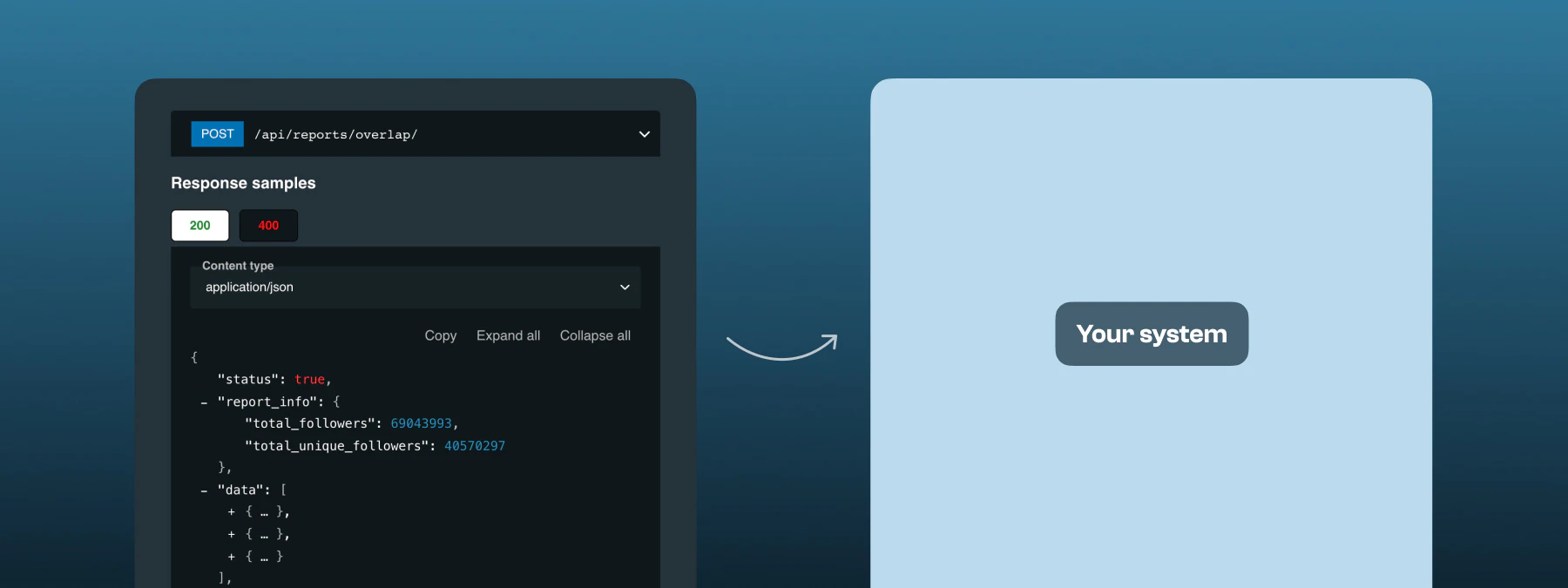
Creators per audience overlap call, for unique reach before a plan is locked.
How the integration works
Send the creator and audience criteria the campaign uses, and read back a manageable set of creator IDs with the filters and record count per network. Page through results with the cursor, and keep the stable creator identifier from each row.
Request the profile, performance, audience and contact fields your team uses to approve a creator. Optional fields can return null, each record carries a snapshot timestamp, and inferred audience attributes are labelled separately from observed metrics.
Map the response to your own tables and upsert on the immutable creator ID, never the display name a creator can change. Handle rate limits and field versions as you write.
Repeat the same request and confirm the record updates without duplicates or dropped fields — testing idempotency, refresh behaviour, 429 retries and your scheduled caching.
Where most integrations start
Query creators across Instagram, TikTok and YouTube by geography, language, content patterns, audience fit and performance signals. The influencer search API returns matching creator records your product can rank, display, enrich or save, and the hosted influencer search tool shows the same workflow a marketer would run.
An influencer database API gives your software access to creator records rather than a static spreadsheet. Pull profiles and audience data into your own database, then refresh the fields on the cadence your workflow needs. Exact fields and availability depend on the resource and platform, so map against the current API documentation.
Data coverage
| Resource | Input | Output | Typical job |
|---|---|---|---|
| Search | Creator and audience criteria | Creator IDs and summary fields | Discovery inside your product |
| Profile enrichment | Creator ID or username | Profile and performance fields | Vetting, scoring, CRM enrichment |
| Audience insights | Creator record | Demographics and audience quality | Audience-fit approval |
| Overlap | 2–9 creators | Shared audience, unique reach | Media-plan efficiency |
| Contacts | Username | Verified email, when available | Outreach routing |
| Monitoring | Campaign and creator list | Tracked posts and metrics | Reporting and dashboards |
If creator data has to live inside your product, portal or warehouse, the API is the route: engineering owns the schema, the interface and the refresh cadence. Teams that want hosted search, analysis and reporting without an integration can start on the platform and move later.
Search across 455M+ creators on Instagram, TikTok and YouTube
Featured in Influencer Marketing Hub Top Platforms 2026 • 5.0 on Capterra
Why teams choose the API
Begin with a six-month commitment, then size usage around the workflows you have validated rather than a forecast you guessed at.
Buy a credit pool and spend it on the calls your product actually makes. Forecast from creators searched or enriched, records refreshed and campaigns monitored.
Consistent resource shapes make creator data easier to fit into an existing service, and easier to keep maintainable as usage grows.
A dedicated account manager stays with the data requirements, the testing and the rollout. Confirm support scope and response times in the commercial terms.
No account needed
 Free influencer reports Browse pre-built reports on top creators, audience quality, engagement, and fake-follower flags included, without creating an account. See free reports
  Fake follower check Run a quick audience-quality check on any creator before you commit budget to outreach. Check a profile Instagram ER Calculator Average ER for any IG handle, in seconds. Search Instagram creators
  YouTube ER Calculator Avg views + ER for any channel. Search YouTube creators
  TikTok ER Calculator Recent post performance + ER for any TT handle. Search TikTok creators Instagram Email Finder Find the public business email behind an IG profile. Find Instagram emails TikTok Email Finder Pull the public email from any TikTok profile. Find TikTok emails YouTube Email Finder Get the business email listed on any YouTube channel. Find YouTube emails TikTok Analytics Tool Key metrics and performance overview for any TT account. Analyze a TikTok account Instagram Profile Analyzer Quick read on growth, post cadence, and engagement health. Analyze an Instagram profile Instagram Finder Search Instagram creators by niche, location, or keyword. Search Instagram creators TikTok User Search Find TikTok creators by username or keyword. Search TikTok creators YouTube Channel Finder Discover YouTube channels by topic or niche. Search YouTube creators Instagram Follower Tracker Track follower growth over time for any IG handle. Track Instagram followers TikTok Follower Count Check the current follower count for any TT account. Check TikTok followers YouTube Subscriber Count Live subscriber count for any YouTube channel. Check YouTube subscribers Instagram Bio Search Find Instagram profiles by keywords in their bio. Search Instagram bios YouTube Channel Crawler Crawl related channels from any YouTube starting point. Find related channels Instagram Email Scraper Extract public contact emails from IG profiles in bulk. Extract Instagram emails
 Three ways teams put the data to work

Clients search, vet and track creators inside the product they already pay you for. IQFluence sits underneath as the data layer, and your interface, workflow and commercial model stay yours.

Pull brand-related creator data, backfill the range your model needs, then build benchmarks, rankings, alerts or internal scores. The API supplies the signals and your team decides what they mean.

Start with a handle or a list, enrich the records with profile, performance, audience and contact data, then write the result straight into your CRM, warehouse or internal service.

Find creators across Instagram, YouTube and TikTok in a 455M-profile database, with 20+ filters for audience fit, engagement quality, and location.
Read more about Influencer Search
Analyze each creator’s profile and audience in one view: average likes, shares, views, engagement rate, post themes, plus audience age and location.
Read more about Influencer Analysis
The IQFluence influencer reporting tool scoops the collab stats and does all the math, so you don’t have to.
Read more about Campaign Reporting
Break down how much of each creator’s audience is shared versus net-new across Instagram, YouTube and TikTok, so you avoid cannibalization, clean up your reach, and plan the budget.
Read more about Audience OverlapAn influencer marketing API is programmatic access to structured creator data you can plug into your own product or internal tools. IQFluence uses that connection to support discovery, profile and audience enrichment, overlap checks, contact enrichment, and campaign reporting across Instagram, TikTok, and YouTube.
Common builds include a white-label creator search product, an internal vetting tool, CRM enrichment, a research dataset, an audience-fit scoring model, and scheduled campaign reporting. The useful starting point is one end-to-end workflow your team already understands, not every endpoint at once.
Send creator and audience criteria such as geography, language, content patterns, and performance signals. The influencer search API returns matching creator records your product can rank, display, enrich, or save. Open the hosted search tool if you want to inspect the marketer-facing workflow before you build it.
An influencer database API gives your software access to creator records rather than a static spreadsheet. With IQFluence, available data can include profile details, performance metrics, audience attributes, contacts, and campaign signals. Exact fields and availability depend on the resource and platform, so map against the current API documentation.
The IQFluence influencer API supports Instagram, TikTok, and YouTube. The same three-platform scope lets teams build one cross-platform workflow while keeping the platform-specific fields their operators need.
Run one realistic integration spike: search with the filters your team uses, enrich a small set of returned creators, write the response to your database, then repeat the run. Confirm stable identifiers, update behavior, missing-field handling, pagination, retries, and duplicate prevention before you model production volume.
Start with a six-month commitment, then scale usage with credits. Ask for the current entry amount and the credit cost of the endpoints in your test plan. That gives you a defensible forecast based on creators searched or enriched, refresh cadence, and campaigns monitored.
You buy a credit pool and calls consume credits according to the resource used. Build the forecast from your own workflow: expected creators per day, enrichment depth, refresh cadence, and campaign-monitoring load. The current endpoint breakdown is available in the API documentation.
IQFluence supports up to 10 requests per second. Confirm the limit for your plan and endpoints, then design queues, retries, caching, and scheduled refreshes around the documented behavior.
API access can be enabled alongside a platform plan, then credits are sized to the data workflow. If your team needs field-level control for ETL or warehouse work, ask about Raw API access. If normalized objects matter more, ask whether Classic is the right route. Confirm the current product names and availability before implementation.
Bring the search, enrichment or reporting job your team wants to automate. We map the data, throughput and credit model around that workflow, then you decide whether it belongs in your stack.
Search across 455M+ creators on Instagram, TikTok and YouTube
Featured in Influencer Marketing Hub Top Platforms 2026 • 5.0 on Capterra